Gunsmithing - A trade devoted to the 2nd Amendment and American Freedom
© Ernie Paull
GUNSMITHING ODDS AND ENDS CLICK ON THE LINKS BELOW #1. Pillar Bedding and the Flexible Rem. Receiver #2. Glass Bedding vs. Aluminum Pillar Bedding See Below for Content #3. Pillar Bedding - It's All About Your Action's "Comfort" #4. Ensure Alignment of Aluminum Bedding Pillars #5. Aluminum Pillar Bedding For a More Accurate Rifle #6. All Stocks Need Pillars, Even Stocks With Aluminum Bedding Blocks #7. Machine "Bed Heads" Pillars to Length #8. Winchester M-70 M.O.A. - Install a Light Trigger Spring #9. M-700 X-Mark Pro Adjustable - Install a Light Trigger Spring #10. CZ M-452 And M-455 - Install a Light Trigger Spring And More #11. Browning A Bolt - Install a Light Trigger Spring
GUNSMITHING ODDS AND ENDS:#2 - GLASS BEDDING vs. ALUMINUM PILLAR BEDDING
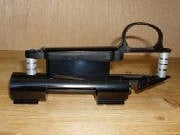
Read one gunsmith's conclusion after 37 years of experience in this area.
When I think of walnut, I think of wood that can be beautiful, but also, the words temperamental and unstable come to mind. Also, I think of the wood stocked rifles that I have handed back to customers over the years, while making predictions, based on grain layout, of how their stock would, or would not warp.
These stocks need pillars.
Laminated stocks are less prone to warp, but are more prone to expand or contract based on moisture content.
If you use one during a rainy hunting season, and then your rifle sits unused through a hot and dry summer, be sure that you re-tighten those guard screws before sighting in again. You may be surprised at how loose those screws can be, and they are loose, because last year's moisture has now evaporated, and the stock has shrunk.
These stocks also need pillars.
Light weight fiberglass stocks are stocks made with a more porous filler. More porosity equals less weight.
More porosity also equals less compression strength.
Some light weight fiberglass stocks can be crushed by guard screw pressure.
These stocks need pillars most of all.
In a stock of wood or fiberglass, you must first install a solid foundation.
I have been glass bedding rifles, and working on rifles which others have glass bedded, since 1972. Experience tells me that usually, when you see that beautiful, smooth, reverse image of an action which has been glass bedded in your stock, it only means that your action is being held firmly in the same position, which has been the problem all along. This is because no portion of the "Glass Bedding" job you are admiring was actually devoted to the "Bedding" half of that title.While the stock was being prepared for that glass bedding job, there was no actual "Spotting In" or "Scraping Away" of "High Spots" involved, or of doing anything else that would provide a more uniform and "Stress Free" support of the action. Always remember, that when you are bedding an action, the strength, and the power, are in those 2 little trigger guard screws, and not in that bar of steel known as the receiver. After that epoxy was applied in the stock, and those guard screws were tightened, they had plenty of clamping ability to pull the action down through the soft epoxy and right back into the action's original position, exactly where it was when the rifle was taken into the gun shop to be glass bedded.Bedding jobs like this rely entirely on the fact that the action will be held tightly and firmly in one position. While it is true that just being held firmly in one position can shrink your group size somewhat, group size will not shrink as much as when you first fix the bedding problem, and then hold the action firmly.The work described above was often done by conscientious workmen and gunsmiths with the best of intentions, and who took real pride in producing quality work. However, I believe that these men just did not understand how powerful the guard screws were, relative to how easy the action is to bend.In their mind's eye, they just did not see a receiver, which could be bent, simply by tightening the guard screws until they felt the receiver contact the bottom surface of the inletting. And yet, it is this simple fact that the receiver WAS pulled back into contact with its original bedding surface that guarantees whatever bedding problems existed before, are still there, and, furthermore, are now captured in epoxy. These gunsmiths were confident that a quality bedding job was simply a matter of creating that beautiful reverse image of your receiver in epoxy. Neither they, nor you, were aware that as the image was formed, your receiver was bent over a high spot located somewhere between the guard screws.During the past 37 years, I have worked in six busy gun shops in three different states. I have seen a lot of glass bedding jobs, done by a lot of different people. And, I have checked a lot of those jobs with a dial indicator. This experience is my defense of the above description, which I believe to be fair and true.In the long term, the standard glass bedding job, without aluminum pillars, can never offer the same degree of accuracy, strength, and stability, which is available with aluminum pillars. In the short term, and in fact, the immediate weakness of that standard glass bedding job is that the receiver was pulled right back into contact with the same bedding surface that had been the problem all along. Two things allowed this to happen: #1 A receiver which bends much more easily than people realize#2 The lack of a solid and accurate foundation to support the receiver while the trigger guard screws are being tightened
The "Bed Heads" installation process is designed specifically to deal with the action flexibility described above and also in Gunsmithing Odds and Ends #1 Step #1 of this process allows you to epoxy the aluminum pillars in place while they are in perfect alignment with the receiver, and while the receiver is under no stress. Once your pillars are epoxied in place under these conditions, your accurate foundation is in place, and the receiver will no longer be bent when the guard screws are installed and tightened. Step #2 of this process is the application of epoxy in a way that maintains the precise, full contact, and stress free support of the receiver.Whether your stock is solid wood, laminated wood, fiberglass, or fiberglass with an aluminum block in it, the receiver is the same.The receiver offers its most uniform results (most consistent accuracy) when it has the most uniform, and stress free support.The farther that support for the receiver strays away from the guard screws, the more leverage there is available to bend, or stress the receiver when the guard screws are tightened. Based on this principle, THE FIX SEEMS TO BE providing SOLID SUPPORT AS CLOSE TO THE GUARD SCREWS AS POSSIBLE. Maybe, we could even provide support entirely around the circumference of the guard screws. Pillars, maybe? In closing, I will include some numbers from Engineer's Edge on the internet. They illustrate how efficient your guard screw threads are at converting a small amount of rotational torque into a surprisingly large amount of clamping force.
5 in. lbs. of torque on a 1/4" screw equals 100 lbs. of clamping force.30 in. lbs. of torque on a 1/4" screw equals 600 lbs. of clamping force.65 in. lbs. of torque on a 1/4" screw equals 1300 lbs. of clamping force.
Give your action a stress-free life, choose "Bed Heads" Aluminum Pillars and do the "Two Step" installation process. It's easy!
I have been glass bedding rifles, and working on rifles which others have glass bedded, since 1972. Experience tells me that usually, when you see that beautiful, smooth, reverse image of an action which has been glass bedded in your stock, it only means that your action is being held firmly in the same position, which has been the problem all along. This is because no portion of the "Glass Bedding" job you are admiring was actually devoted to the "Bedding" half of that title.While the stock was being prepared for that glass bedding job, there was no actual "Spotting In" or "Scraping Away" of "High Spots" involved, or of doing anything else that would provide a more uniform and "Stress Free" support of the action. Always remember, that when you are bedding an action, the strength, and the power, are in those 2 little trigger guard screws, and not in that bar of steel known as the receiver. After that epoxy was applied in the stock, and those guard screws were tightened, they had plenty of clamping ability to pull the action down through the soft epoxy and right back into the action's original position, exactly where it was when the rifle was taken into the gun shop to be glass bedded.Bedding jobs like this rely entirely on the fact that the action will be held tightly and firmly in one position. While it is true that just being held firmly in one position can shrink your group size somewhat, group size will not shrink as much as when you first fix the bedding problem, and then hold the action firmly.The work described above was often done by conscientious workmen and gunsmiths with the best of intentions, and who took real pride in producing quality work. However, I believe that these men just did not understand how powerful the guard screws were, relative to how easy the action is to bend.In their mind's eye, they just did not see a receiver, which could be bent, simply by tightening the guard screws until they felt the receiver contact the bottom surface of the inletting. And yet, it is this simple fact that the receiver WAS pulled back into contact with its original bedding surface that guarantees whatever bedding problems existed before, are still there, and, furthermore, are now captured in epoxy. These gunsmiths were confident that a quality bedding job was simply a matter of creating that beautiful reverse image of your receiver in epoxy. Neither they, nor you, were aware that as the image was formed, your receiver was bent over a high spot located somewhere between the guard screws.During the past 37 years, I have worked in six busy gun shops in three different states. I have seen a lot of glass bedding jobs, done by a lot of different people. And, I have checked a lot of those jobs with a dial indicator. This experience is my defense of the above description, which I believe to be fair and true.In the long term, the standard glass bedding job, without aluminum pillars, can never offer the same degree of accuracy, strength, and stability, which is available with aluminum pillars. In the short term, and in fact, the immediate weakness of that standard glass bedding job is that the receiver was pulled right back into contact with the same bedding surface that had been the problem all along. Two things allowed this to happen: #1 A receiver which bends much more easily than people realize#2 The lack of a solid and accurate foundation to support the receiver while the trigger guard screws are being tightened
The "Bed Heads" installation process is designed specifically to deal with the action flexibility described above and also in Gunsmithing Odds and Ends #1 Step #1 of this process allows you to epoxy the aluminum pillars in place while they are in perfect alignment with the receiver, and while the receiver is under no stress. Once your pillars are epoxied in place under these conditions, your accurate foundation is in place, and the receiver will no longer be bent when the guard screws are installed and tightened. Step #2 of this process is the application of epoxy in a way that maintains the precise, full contact, and stress free support of the receiver.Whether your stock is solid wood, laminated wood, fiberglass, or fiberglass with an aluminum block in it, the receiver is the same.The receiver offers its most uniform results (most consistent accuracy) when it has the most uniform, and stress free support.The farther that support for the receiver strays away from the guard screws, the more leverage there is available to bend, or stress the receiver when the guard screws are tightened. Based on this principle, THE FIX SEEMS TO BE providing SOLID SUPPORT AS CLOSE TO THE GUARD SCREWS AS POSSIBLE. Maybe, we could even provide support entirely around the circumference of the guard screws. Pillars, maybe? In closing, I will include some numbers from Engineer's Edge on the internet. They illustrate how efficient your guard screw threads are at converting a small amount of rotational torque into a surprisingly large amount of clamping force.
5 in. lbs. of torque on a 1/4" screw equals 100 lbs. of clamping force.30 in. lbs. of torque on a 1/4" screw equals 600 lbs. of clamping force.65 in. lbs. of torque on a 1/4" screw equals 1300 lbs. of clamping force.
Give your action a stress-free life, choose "Bed Heads" Aluminum Pillars and do the "Two Step" installation process. It's easy!
Remember Ernie's Rule:For the least amount of stress in your action, build your action's foundation while using the least amount of force!